
Affordable, reliable, and environmentally friendly electricity distribution
A more affordable electricity transmission price fosters well-being and improves the competitiveness of our region.
Lower electricity transmission price
The purpose of Keravan Energia and Sipoon Energia is not to generate profit for their owners, but to foster well-being in our region. Our core mission is to offer more affordable electricity transmission rates to our customers in both Kerava and Sipoo. We are committed to ensuring that our customers continue to benefit from low electricity transmission costs, without compromising the quality of electricity distribution.
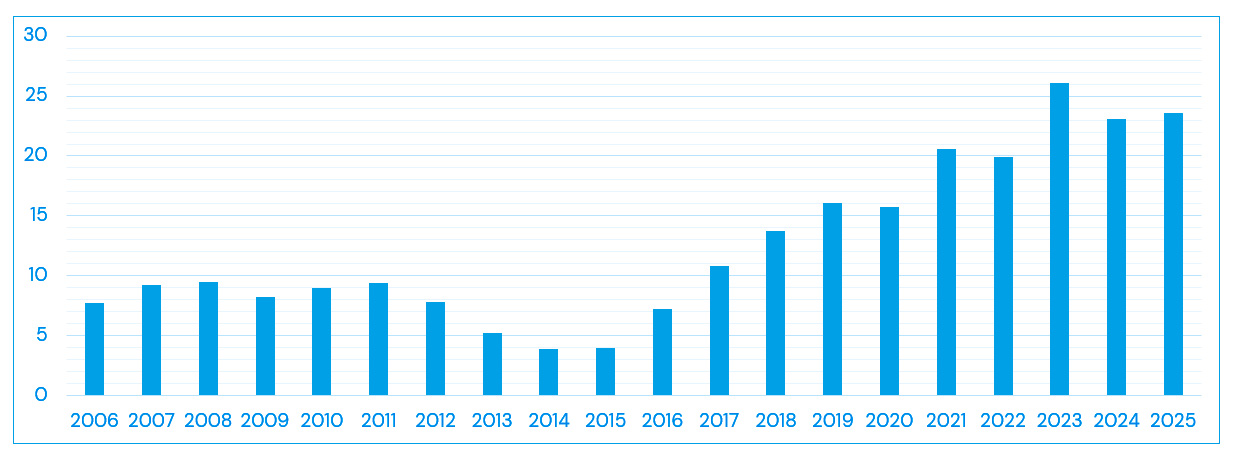
For a long time, electricity transmission rates in Kerava have been among the most affordable in the entire country. Rather than our owner—the City of Kerava—collecting dividends, the value generated by the company is passed directly to all local residents and businesses in the form of lower energy prices. In 2025, this calculated benefit to the region amounted to 23.6 million euros.
This benefit—or calculated value returned to the community—is determined by comparing our operations against a selection of peer companies, primarily from neighboring areas and other regions that are demographically and geographically comparable. Based on the financial statements of these selected companies, the analysis calculates the savings realized by residents in our service areas regarding electricity transmission and district heating.
Goal: less power outages
Our electricity networks are located in Kerava and Sipoo. From the perspective of electricity distribution, these two areas are very different from each other. Kerava is a small, densely built-up town where the electricity network has been placed underground for decades.
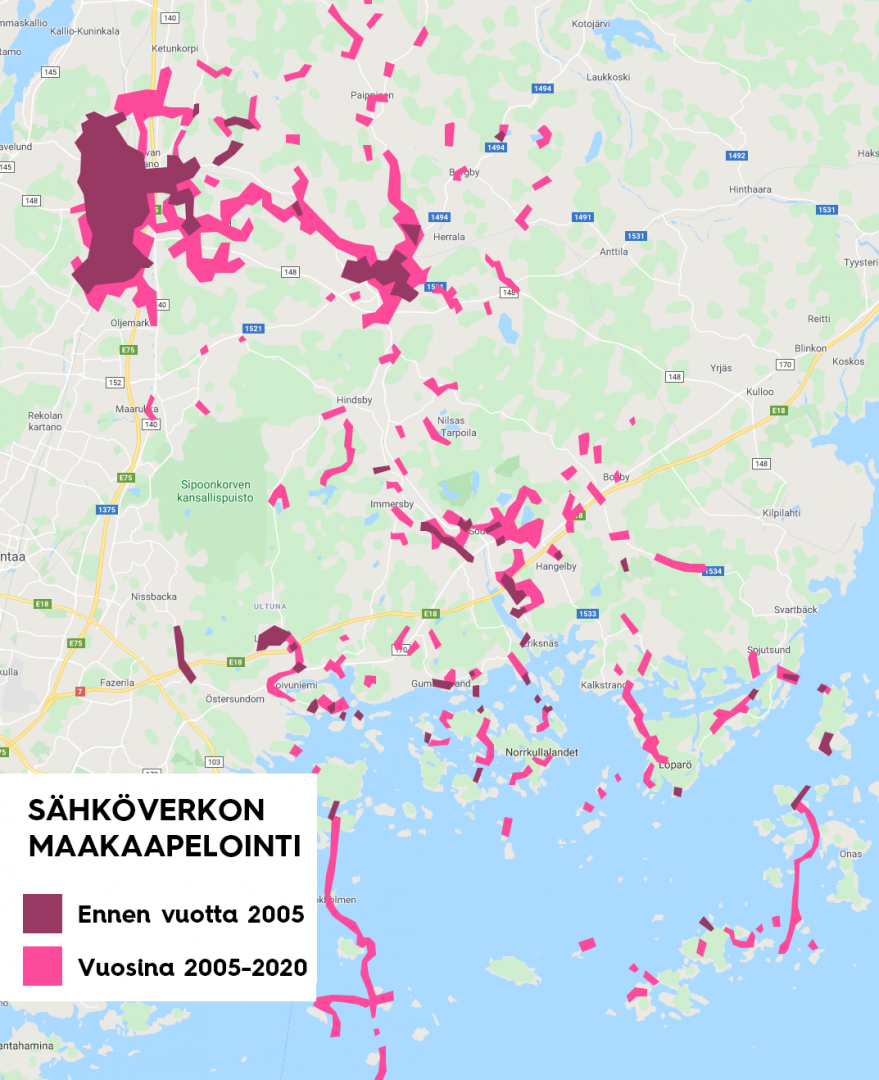
Sipoo, for its part, is a vast and sparsely populated area characterized by extensive forests and fields. We are working consistently to improve the reliability of electricity supply, with the goal of having more than 60 percent of the electricity network in Sipoo converted to underground cabling by 2028.
In Sipoo, there are approximately 1,250 kilometers of overhead lines, whereas in Kerava, the corresponding figure is only 62 kilometers. Overhead lines are more susceptible to weather-related disruptions, which is why we aim to place as much of our electricity network underground as possible. Currently, the share of the network that is underground in Sipoo is approximately 40%, compared to less than 5% at the turn of the millennium.
In addition to installing underground cables, we are improving the reliability of electricity supply and reducing power outages through other means as well:
An intelligent fault-location system allows faults in the electricity network to be isolated to a small area within minutes, enabling power to be restored very quickly for the vast majority of customers.
The reliability of electricity distribution in Sipoo is being enhanced through the construction of a high-voltage ring network. This ring network will run from the Anttila substation—located on the border of Sipoo and Porvoo—through Central Sipoo and Kerava, then along the border of Vantaa and Helsinki into Southern Sipoo, before finally returning to Anttila. The new ring network will reduce the number of power outages, as electricity can be rerouted via an alternative path in the event of a fault, allowing the affected area to be isolated. At the same time, power transmission capacity will increase from 70 megawatts to as much as 250–300 megawatts.
We are improving the reliability of the overhead line network by clearing vegetation along approximately 300 kilometers of the network each year. For overhead lines, factors such as gusty winds and heavy snow loads can cause power outages if trees fall onto the power lines. The entire overhead line network is cleared on a five-year cycle.
Minimizing environmental damage
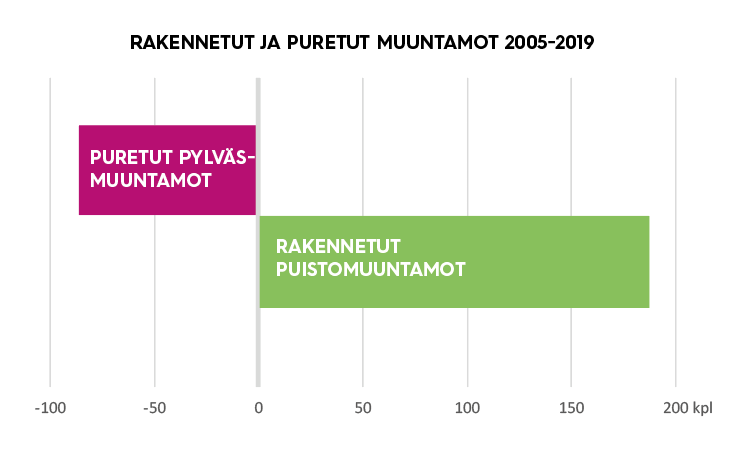
We build and maintain our electricity network in an environmentally sustainable manner. We are systematically replacing old pole-mounted transformers with ground-mounted (pad-mounted) transformers. Transformers contain oil, which is harmful to the soil if it leaks into the environment during a fault. Ground-mounted transformers are safer than pole-mounted ones, as they prevent oil from reaching the soil.


