
Joustosähkö
The name Joustosähkö means flexible electricity. If you want an electricity contract that moves according to how you spend electricity. You have a fixed basic price that either rises or lowers following your spending. If you use energy wisely, the consumption effect lowers the price you pay for it. And if you only use energy when it is expensive, your price may go up.
Our Joustosähkö contracts
How is the price formed?
Joustosähkö pricing consists of three components:
- fixed basic price of electricity (c/kWh)
- fixed monthly basic fee (€/month)
- consumption effect that varies (+/- c/kWh)
The base price and fixed monthly fee are set and do not change during the contract period. Your final electricity price consists of the base price plus a consumption-based adjustment.
The consumption-based adjustment is calculated by comparing your electricity consumption prices with the monthly average price of exchange electricity. Depending on how you time your electricity use in relation to the monthly average spot price, your consumption effect will either decrease or increase your electricity price.
The consumption effect increases your monthly electricity price if you mainly use electricity when spot prices are higher than the monthly average. Conversely, it decreases your monthly price if you mainly use electricity when spot prices are lower than the monthly average.
Please note: the contract can be made no more than 90 days before its start date.
The consumption effect is not a fixed price
Your consumption effect varies from month to month, meaning it is not fixed. Based on our customers’ consumption patterns, we have observed that it typically ranges around ±3 c/kWh.
However, there are no upper or lower limits for the consumption effect. In one month it may be -4 c/kWh if you have used electricity during lower-priced periods, while in another month it may be +3 c/kWh if your usage pattern shifts compared to the previous month.
The consumption effect is always calculated retrospectively during billing, based on your electricity consumption during each metering period and the corresponding spot market prices.
Ultimately, the consumption effect depends on how well you are able to align your electricity use with the monthly average price level.
Not all days are equal
In general, using electricity during lower-priced hours helps reduce your consumption effect. However, it is important to understand that even if you shift your usage to cheaper hours within a day, those hours may still be relatively expensive compared to similarly “cheap” hours on other days.
Prices are evaluated on a monthly basis, meaning that the monthly average price is also influenced by more expensive days. Conversely, if electricity prices are generally high but there are some very inexpensive days (for example, even negative pricing), the effect works in the opposite direction.
You can benefit from low-price days, but you also carry a small risk from high-price days. However, this risk is lower than with a pure spot price electricity contract.
Consumption calculator – test your flexibility
With our consumption calculator (in Finnish only), you can explore how much flexibility your household could achieve in electricity pricing with Joustosähkö.
The results provided by the calculator are estimates based on the average consumption of real-life example households.
On average, our customers’ consumption effect in 2023 was +0.13 c/kWh.
The price of Joustosähkö is made up of three components
- Fixed electricity base price (c/kWh))
i.e. the agreed electricity price in your contract, charged according to your consumption - Fixed monthly basic fee (€/kk)
i.e. a fixed monthly fee that remains the same regardless of your consumption - Consumption effect that varies (+/- snt/kWh)
i.e. a variable component based on market electricity prices and your own consumption habits, which increases or decreases your electricity price depending on how you use electricity
How can you benefit from Joustosähkö?
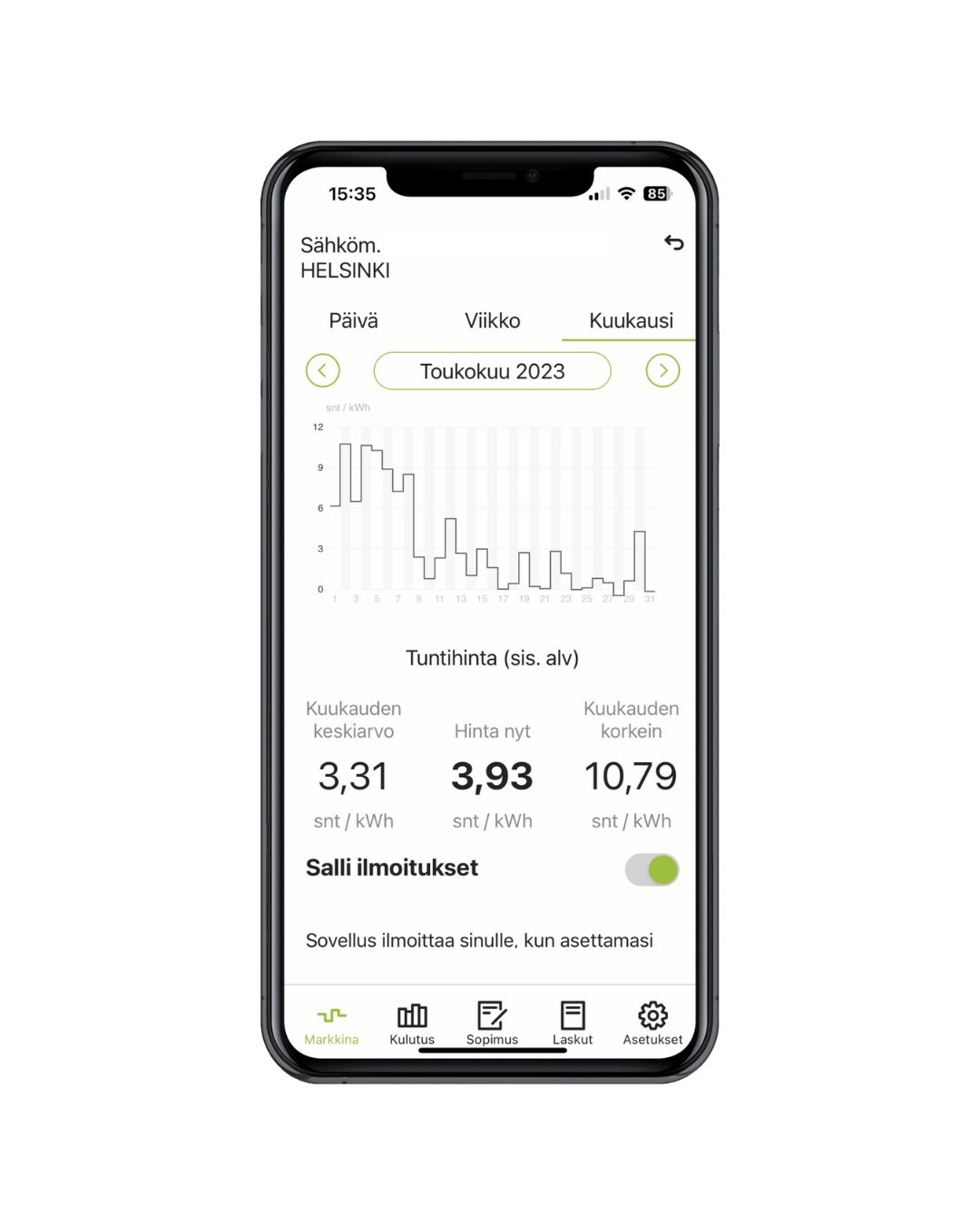
- Follow electricity price fluctuations in the Keravan Energia app so you know when electricity is cheap and when it is expensive.
- Monitor your electricity usage to understand when you typically consume the most energy. This makes it easier to shift your consumption to times when electricity is cheaper.
Joustosähkö is a fixed-term electricity contract with features of spot electricity pricing
Joustosähkö is a safe and stable option because its core principle is a fixed-term electricity contract. The base price is based on electricity purchased from the derivatives market, as in all standard fixed-term electricity contracts. This means we have purchased the amount of electricity corresponding to your estimated annual consumption in advance for the entire contract period at a fixed price.
In a fixed-term electricity contract, the price per kWh remains the same throughout the contract period, and fluctuations in the Nordic electricity market do not affect the price. This is why fixed-term contracts are often popular in households that need predictable electricity costs.
In Joustosähkö, market price fluctuations do not affect the fixed base price. Only your own consumption—whether you use electricity during cheaper or more expensive hours compared to the monthly average price—affects your final electricity price. This is called the consumption effect.
Consumption effect – what does it mean and how does it work?
Consumption effect (sometimes also called consumption elasticity, usage effect or profile cost) means that the final price you pay in a moths is affected by your own usage of electricity. The basic price is fixed but you may get a small increase or decrease to it depending on how you have been using electricity. The difference between your consumption and how other electricity users have behaved is your consumption effect.
The Consumption Effect and the Nord Pool Electricity Market
You benefit from the consumption effect when you use electricity in those times when it is cheap at the Nord Pool electricity exchange.
How Joustosähkö differs from the regular fixed-term electricity contracts is that there is an elastic pricing element (consumption effect) involved, that is based on the Nordic electricity exchange prices. Exchange priced electricity contract prices are set at the Nord Pool exchange.
The price of electricity is at its highest during the times of day when there is the most consumption. Typically those times are on weekdays between 07:00 and 09:00 in the morning and early evening when people come home from work. The cheapest times are often at night between 02:00 and 04:00. How much of your consumption you can move to those cheapest times defines your consumption effect and how much you eventually pay for electricity. In other words, if you use electricity fairly evenly during both cheap and expensive times, your consumption effect is 0 c/kWh or close to 0, meaning that your price will be the fixed basic price.
The “Everyone Else” Effect
When you use electricity at the same time as most other people in Finland, your price increases through the consumption effect. However, if you can shift your electricity use to nighttime or weekends, you’ll pay less for your electricity.
By using electricity when demand is lower—for example, while most people are asleep—you can reduce your electricity costs through the consumption effect. Even a small change can make a difference. For example, starting your electric sauna at 8 p.m. instead of 7 p.m. can help lower your electricity price.
When is Joustosähkö the right choice?
When you want the price security of a fixed-term electricity contract for 6, 12 or even 24 months.
When you own an electric car that you charge overnight.
When you want to avoid the price volatility of a pure spot-price electricity contract.
How is the consumption effect calculated?
We calculate the average price for the month by multiplying the exchange price of each time period with your consumption during the same time. Then we divide the total of that with your total consumption for the month. The difference of this weighted average and the general average of the month is your consumption effect that is either added to your price or discounted from it.
We calculate the weighted average of the consumption effect that is compared to the month’s average the following way:
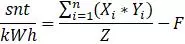
∑ = sum of all days of the month
X = consumption of the time period (kWh)
Y = the exchange price of the time period (snt/kWh)
Z = the total electricity consumption of the month (kWh)
F = Average Finnish area spot price during the billing period (c/kWh)
Here are a couple of examples based on real cases:
A detached house with electric heating system
Total consumption for the month is 1 800 kWh (Z). Your combined consumption total is 17 388 cents (X*Y). 17 388 c/1 800 kWh = 9,66 c/kWh, which is your weighted average price. The monthly average of the exchange price has been 11 c/kWh.
This makes your consumption effect to be 9,66–11 = –1,34 c/kWh.
When the consumption effect is negative, that lowers the final price you pay for the month. For example, if your fixed basic price is 9,90 c/kWh, your final price for the month would be 8,56 c/kWh in this case.
Apartment duplex with district heat
Total consumption for the month is 160 kWh (Z). Your combined consumption total is 1974,4 cents (X*Y). 1974,4 c/160 kWh = 12,34 c/kWh, which is your weighted average price. The monthly average of the exchange price has been 11 c/kWh.
So this makes your consumption effect to be 12,34–11 = 1,34 c/kWh.
When the consumption effect is positive, that raises the final price you pay. For example, if your fixed basic price is 10 c/kWh, your final price for the month would be 11,34 c/kWh.
Note: If your contract starts or ends partway through a calendar month, both the monthly average spot price and your weighted average consumption price are calculated only for the contract period. For example, if your electricity contract starts on 15 January, the averages for the first billing period are calculated for 15–31 January, not for the entire calendar month.

Cheap electricity is often the most environmentally friendly
Cheap electricity is often the most environmentally friendly
Did you know? When electricity prices are at their lowest, electricity is also usually at its most environmentally friendly. Low prices typically occur when there is plenty of wind and wind power generation is high. Shifting your electricity use to times when the grid is under less demand is also a more sustainable choice.
During these periods, electricity is generally at its cheapest, and there is less need to rely on more polluting forms of power generation.